
Get in touch: 410-505-8079
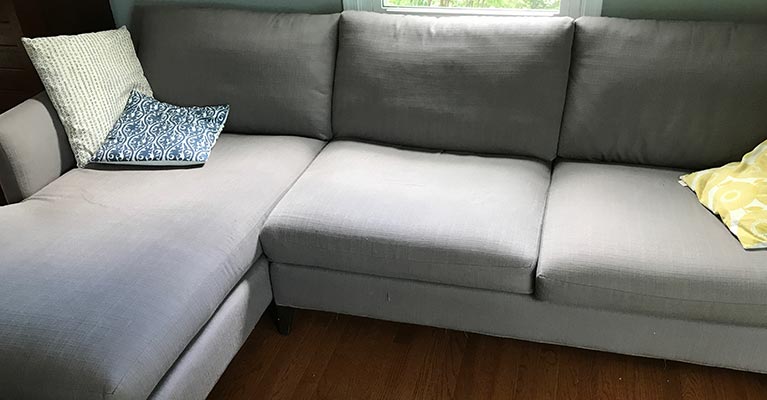

Most cleaning pages describe every textile surface with the same promise: deep cleaning, fresh results, fast service. That is not how the work looks from a technician's side.
A carpet lane, a wool rug, and a sofa arm can sit a few feet apart, yet each one calls for its own inspection. Fiber, backing, dye stability, cushion fill, soil type, wear, access, and drying conditions all shape the cleaning plan.
At Baltimore Carpet & Upholstery, we clean carpets, area rugs, and upholstered furniture for homes and businesses in Baltimore's Hampden neighborhood. Our carpet cleaners start by looking closely at the surface in front of us.
We check
Then we explain what we see.
Call 410-505-8079 to schedule carpet, rug, or upholstery cleaning in Baltimore's Hampden neighborhood.
A technician can learn a great deal in the first few minutes.
We look at how the carpet pile lays across a traffic lane. We check the edge of a rug for loose yarns or brittle backing. We inspect sofa arms for body-oil buildup and old spot-cleaner residue. We look under cushions, near baseboards, along stair edges, and beneath rug corners.
Those details tell our carpet or upholstery cleaners far more than the room size alone.
A dark area may be removable soil. It may be an abrasion. It may be sticky detergent left behind after repeated home treatments. On upholstery, a dark mark may sit on the fabric's surface, or it may have reached the cushion beneath. On a rug, discoloration near the fringe may come from soil, dye movement, a previous cleaning attempt, or wear.
We do not promise a result based on a quick glance. We inspect, test, and explain.
Our technicians regularly encounter Hampden living rooms with installed carpet, an area rug, and a fabric sectional sharing the same space. Years of field experience have shown us why one cleaning product should never be used across all three surfaces. Each textile has its own fiber, backing, dye, fabric, and moisture concerns.
| Surface | What Guides Our Decision | What We Inspect Closely |
|---|---|---|
| Wall-to-wall carpet | Fiber, backing, padding, traffic, soil, and wear | Dark lanes, stairs, edge soil, spots, and access |
| Area rugs | Construction, dyes, fringe, backing, and foundation | Color stability, loose edges, grit, worn areas, and the floor beneath |
| Upholstery | Fabric, cleaning code, cushion design, and moisture sensitivity | Body oils, dye transfer, texture, residue, seams, and hidden test areas |
The equipment may look familiar from one room to the next, but the decisions our technicians make change with the textile.
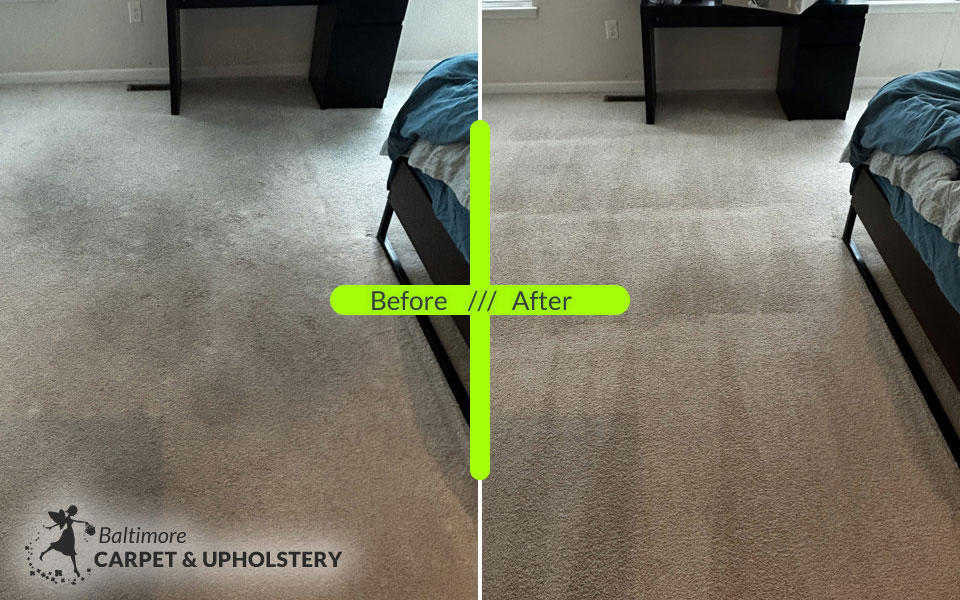
Carpet records movement. In many Hampden rowhomes, the heaviest lane runs from the front door toward the living room, then continues toward the kitchen or stairs. The quiet corners stay brighter. The main path grows darker and flatter.
That darker lane is not always dirt alone.
Repeated foot traffic can bend, crush, and abrade the pile. Once the fiber surface is worn, it reflects light from another angle. Carpet cleaning can remove soil from that lane, yet the worn section may still appear shaded.
We point this out early. Customers deserve to know the difference between removable soil and permanent wear.
Here is what we check:
Those clues help us set a fair expectation.
 Ask for Special Seasonal Offers
We regularly find spots that have been treated several times. The original spill may be small, yet the treated area becomes wider. Soap can remain in the pile, attract new soil, and leave a ring after drying.
More cleaner can make the area harder to rinse. For guidance on treating a fresh spill, review the Carpet and Rug Institute's Spot Solver before applying another cleaning product.
Our technicians usually spend more time removing old residue than treating the original spill. That detail rarely appears on generic service pages, but it plays a major role in real carpet cleaning.
Stairs carry concentrated traffic across a narrow strip. The leading edge takes repeated pressure. Soil packs into the curve. The pile may flatten long before the center of a bedroom shows the same wear.
We inspect each part of the staircase as its own cleaning zone:
Tight turns and limited working space can affect equipment placement, a common concern in Hampden rowhomes.
Customers usually call because a rug looks dull, stained, or gray. A technician starts with another question, "How is the rug made?"
That answer shapes nearly every decision.
A tufted rug can have adhesive in the backing. A hand-knotted rug can carry unstable dyes or fragile fringe. A machine-made synthetic rug may tolerate a cleaning process that would be risky for an older wool piece. A braided rug brings its own edge and stitching concerns.
Our inspection may include:
A rug may look clean on the surface and still hold grit deep in the pile. Those particles act as an abrasive each time the rug is walked on. Vacuuming removes a great deal of surface debris, but dense rug construction can trap grit deeper in the foundation, where professional rug cleaning can reach it more effectively.
A dull rug does not automatically need a stronger product. The technician needs to know how the dye, fiber, backing, and fringe may respond.
Testing gives us that information. It can reveal dye movement, texture sensitivity, or prior treatment residue. A careful plan protects the rug from a cleaning method that is too aggressive for its construction.
The rug and the floor beneath it affect each other. Fine grit can scratch hard flooring. Moisture can become trapped under a rug with a dense backing. A failing pad can leave dust or residue below the rug.
We check beneath accessible rugs because the top surface tells only part of the story.
Our technicians inspect the arms, headrests, seat fronts, and most-used cushions early in the visit because these areas receive the greatest direct contact.
Body oils hold dust and dry soil against the fabric. Food residue, pet contact, hand lotion, hair products, and old spot treatments can be collected in the same areas. This is why a sofa arm can appear much darker than the back panel.
Our technician always checks:
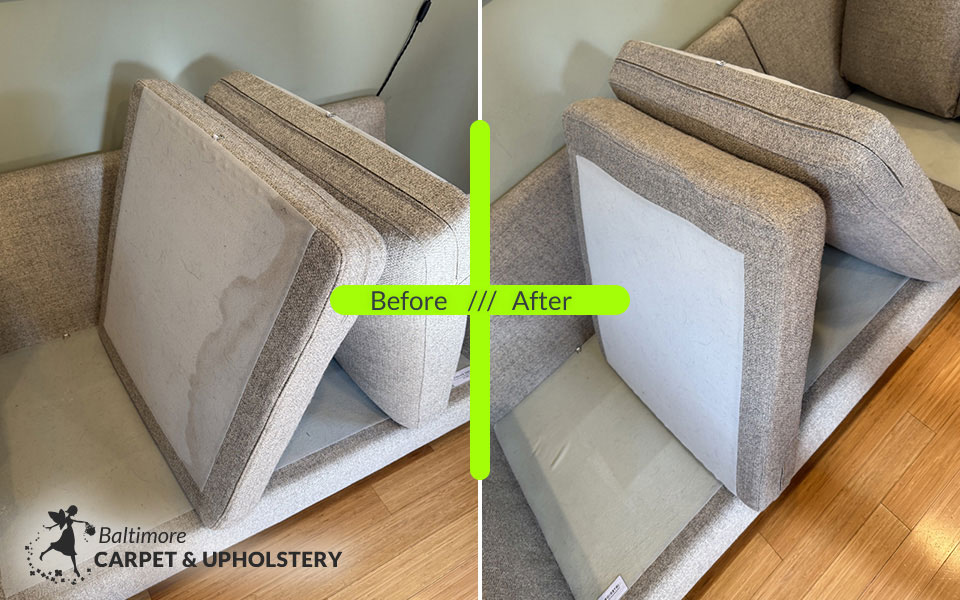
The visible fabric may react one way, and the cushion beneath it may react another way. Excess moisture can carry soil into the cushion fill or draw it back toward the surface during drying. Careful application and extraction are essential during an upholstery cleaning appointment.
Hard scrubbing may disturb the nap or texture. Too much moisture may leave a ring on a sensitive fabric. A heavy product can create residue that attracts fresh soil.
We prefer a measured cleaning process. We test the sofa fabric, work in small sections, monitor how it responds, and keep moisture under control.
That is technician judgment, not a one-product routine.
Hampden homes have character, and many have tight working areas. Narrow front entries, steep stairs, compact landings, limited curb space, and rooms with several uses can shape the cleaning plan.
For example, during one local appointment, we planned the equipment route and room order carefully because the sofa was on the second floor and the carpet was on the first. The narrow staircase limited where we could safely place hoses and tools.
Sharing a few details during scheduling helps us prepare:
Good planning keeps the visit organized and reduces unnecessary movement inside the property.
As carpet cleaners, we have this conversation early in many appointments.
Professional cleaning can remove soil and improve many spots, but it cannot reverse every type of damage.
Carpet fibers can lose color. Rug dyes can shift after a spill. Upholstery fabric can show abrasion on your favorite seat. Pet contamination can reach padding, backing, cushion fill, or the foundation of a rug. Sun exposure can cause more fading on one side of a room than the other.
During our inspection, we separate removable soil from permanent fiber or material change.
That distinction gives customers a clearer picture of the result they can expect and keeps the conversation honest.
Pricing reflects the actual surfaces and the work required.
A lightly soiled bedroom carpet does not call for the same evaluation as a wool rug with fringe concerns or a sectional with heavy body-oil buildup. Room count alone cannot describe the job accurately.
Pricing may reflect:
Call 410-505-8079 and tell us what you want to be cleaned. A useful description helps us discuss pricing, scheduling, and the options available for your project.
A worn carpet lane, a gray rug, and a dark sofa arm may look related at first glance. The causes can be far apart.
Our technician will inspect the surface, explain the condition, and discuss the cleaning plan for each item.
Call us at 410-505-8079 to schedule carpet cleaning, area rug cleaning, or upholstery cleaning in Hampden, Baltimore, MD.
Move small, fragile, and valuable items out of the cleaning area. Tell us about large furniture, tight stairways, rugs under heavy pieces, or items that must stay in place. These details help our technicians plan access, equipment placement, and room order.
Drying time varies by material, construction, soil level, airflow, indoor humidity, and the cleaning method used. Keep people and pets off cleaned surfaces until they are dry, then follow the technician's care instructions.
Some stains and odors may remain after professional cleaning. Spills and pet contamination can reach carpet backing, padding, cushion fill, or a rug foundation. Our technicians inspect the affected area and explain what cleaning is likely to improve.
A carpet spot can return when residue or soil rises from deeper layers during drying. This process is called wick-back. The technician may need to rinse the area again, reduce remaining residue, or treat the source below the surface.
Yes, in many cases, all three can be cleaned during one visit. Our technicians inspect each surface separately and select the products, tools, moisture level, and cleaning steps suited to the carpet, rug, or furniture.